

 8 min read



55% of employees say they use AI for work or education, but only 35% of businesses with 10 or more staff say they use it at all, according to the Office for National Statistics.
The two figures come from different surveys, so the gap is a signal, not a precise count, and the employee figure includes education and more informal use. But the ONS’s own explanation is the one that matters for HR: employees may be using AI tools independently, as part of their day-to-day work.
That changes the question. Whether AI has arrived at work is settled. What matters now is whether anyone is governing the AI that’s already in use, and the evidence suggests many organisations aren’t yet ready to.
This piece looks at what the data says about that gap: how far use has run ahead of governance, how ready HR says it is, what the regulator has found, and what “ready” actually looks like.
Explore: Is AI Coming for HR Jobs?, for why HR’s role is growing as AI spreads.
The Gap Between Use and Governance
The same ONS data shows how shallow most business adoption still is. Among businesses with 10 or more staff, the ONS found:
- Only 10% of those using AI say they use it extensively
- 15% say more than half their employees use AI in their daily work
- Only 11% say more than half their workforce has had any AI-related training
The ONS treats the first two as early indications, because the questions are new.
When businesses are asked what’s holding them back, governance barely registers. Lack of expertise is among the most cited barriers, alongside cost, while regulatory issues and employee concerns are reported less often, and 41% report no barriers at all.
Our reading: taken together, these figures suggest AI is spreading through individual use faster than organisations are training people or setting rules for it. Some of the AI used at work is likely happening outside any policy or oversight, and that is where HR’s exposure sits.
How Ready HR Says It Is
The best UK evidence on readiness comes from the CIPD, whose 2026 survey of 1,342 people professionals and business leaders, run by YouGov in January and February, looked directly at organisational capability.
Most organisations are still experimenting, often without the foundations. Around 45% of organisations say their use of AI is still ad hoc or experimental, and 42% of those fall into the CIPD’s lowest readiness group. That means they are weak across the core areas the CIPD measured:
- governance and oversight of AI use
- supporting infrastructure and systems
- an innovation culture
- workforce transformation planning
Policies and training lag behind permission. CIPD’s Autumn 2025 survey found:
- 61% of employers allow staff to use generative AI
- only 31% had worked on a generative AI policy in the past year, though that is up from 16% two years earlier
- 35% had provided training and support
- 25% had set up an AI working group
HR’s own confidence is strongest on ethics and weakest on redesign. The CIPD’s 2026 data, split by role, shows real strengths and clear gaps:
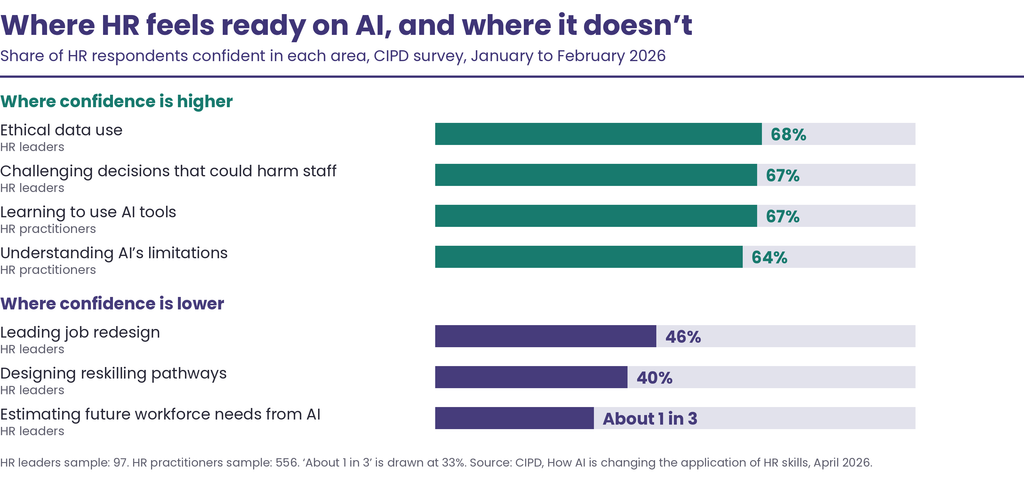
Senior leaders, meanwhile, are less confident about their legal responsibilities. The CIPD also notes that AI decisions are often led outside HR, even though their impact runs across the whole organisation, which makes early HR involvement critical.
These are self-reported confidence levels, and the HR leader group in the sample is small, at 97 people, so the figures show direction rather than precise measurement. The direction is still clear: HR brings the instincts that governance needs, but many organisations haven’t built the structures to use them.
Where the Regulator Has Found Gaps
Self-reported readiness is one measure. What the regulator found when it looked at real practice is another.
In March 2026 the ICO published Recruitment Rewired, based on its engagement with more than 30 employers between March 2025 and January 2026. Its key finding is that many employers using automated recruitment are likely relying on solely automated decisions, made without meaningful human involvement, that significantly affect candidates. That brings them under stricter rules, and the ICO says more safeguards are needed than its evidence suggests are in place.
The ICO also found that employers need to:
- tell candidates more clearly how automated tools are used in recruitment
- apply human review consistently, to every candidate at a given stage, not just some
- do more to monitor their tools for fairness and bias
The ICO is clear that automated tools can help employers and candidates alike, and says it supports innovation. Its findings come from voluntary engagement, not an audit or investigation, but the ICO describes the report as a call to action for employers.
The rules behind this changed in February 2026. Under section 80 of the Data (Use and Access) Act 2025, significant decisions made solely by automated means are allowed only with safeguards in place, giving the person:
- information about the decision
- the chance to make representations
- human intervention
- the right to contest it
The ICO consulted on updated guidance on how these rules apply between March and May 2026. The final version had not been published by mid-October 2026, so organisations are working from a draft, which is all the more reason to get the basics right now.
Explore: AI and the Employment Rights Act 2025: Where the Real Risk Sits, for how these safeguards meet the Act’s new rights.
Why It Matters More From January 2027
The stakes rise in January. From 1 January 2027, unfair dismissal protection starts after six months’ service and the compensation cap is removed.
That raises the cost of weak AI governance. Consider a dismissal that was in effect decided by an automated system, without meaningful human involvement or the safeguards above. It could now involve someone with as little as six months’ service, and expose the employer to a data protection breach and an uncapped unfair dismissal claim from the same decision. That is our reading of how the two sets of rules meet, not a tested case.
Discrimination is a separate exposure, and it doesn’t wait for January. Protection against discrimination applies from day one and is unchanged by the Act. An AI tool that puts people with a protected characteristic at a particular disadvantage can amount to indirect discrimination under the Equality Act 2010, unless the employer can justify it.
Explore: What January 2027 Will Look Like for HR Teams Under the Employment Rights Act and AI, Bias and Discrimination Claims.
What “Ready” Actually Looks Like
Being ready doesn’t require a finished AI strategy. Based on what the CIPD and the ICO actually set out, it means getting a handful of basics in place:
- Know where AI is used, and by whom. The CIPD puts identifying where AI is already being used among the first priorities for organisations at an early stage. That includes tools staff may have adopted on their own.
- Set clear guardrails that people know about. The CIPD lists clear guardrails among its early priorities, yet, as the figures above show, fewer than a third of employers have recently worked on a policy.
- Build baseline AI literacy. The CIPD recommends building it across the workforce, and with only 11% of businesses having trained most of their staff, this is where many organisations are furthest behind.
- Make human review real, and apply it to everyone. The ICO expects meaningful human involvement to be applied consistently to all candidates at a given stage, not just some.
- Tell people when AI is involved. The ICO says employers must improve how they inform candidates about automated decision-making.
- Check tools for bias. The ICO wants employers to expand their monitoring for fairness and bias.
- Give people a route to challenge. Where a significant decision is made solely by automated means, the law requires the right to contest it and to ask for human intervention.
- Bring HR in early. AI decisions are often led outside HR, so HR’s role should start when a tool is chosen, not after it causes a problem.
None of this depends on the ICO’s final guidance. It is what good practice already looks like, and it draws on judgement HR already has, from ethical data use to challenging decisions that could harm staff.
Explore: Building an AI Grievance Policy Before You Need One, for what to do when someone does challenge an AI-influenced decision.
How Avado Can Help
Closing the gap between AI use and AI governance starts with HR’s own capability. Avado’s own 2026 survey of 188 HR professionals points the same way as the national data, finding that 40% of organisations have no AI policy for HR.
Avado’s AI for HR Bootcamps are three live online half-day workshops, each for up to 20 participants and aligned to CIPD professional standards. They take HR teams step by step from practical data privacy guardrails, through shared workflows and an adoption plan, to a governance framework and roadmap for safe, ethical AI use.
Explore AI for HR Bootcamps and help HR move from experimenting with AI to governing it!