
 10 min read


The UK government wants employers to open around 200,000 genuine entry-level jobs over the next decade. Its Digital and Technologies Jobs Plan, published on 21 October 2026, calls it an ambition, not a forecast, and it depends on employers choosing to take part. The ask isn’t limited to tech firms: it calls on every employer, public or private, to commit by 2030.
The plan’s diagnosis matters more than its target. The government says entry-level work isn’t disappearing, but employers’ expectations are changing faster than the routes in, and as AI grows, employers “will need to redesign entry-level roles rather than simply reduce them”.
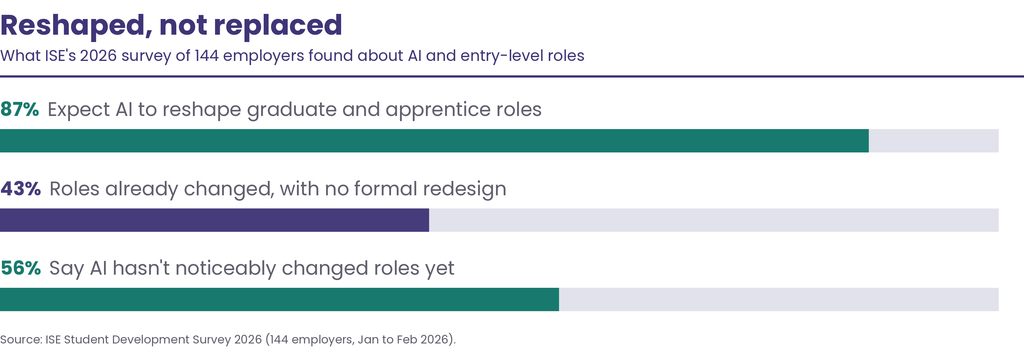
That redesign is already happening, mostly by accident. In the Institute of Student Employers’ 2026 survey, 43% of employers said their entry-level roles had already changed in response to AI without being formally redesigned. This piece argues that turning that into deliberate design is now HR’s job.
Explore: Career Guide: Future-Proofing Your Role in the AI Era, for the same shift seen from the job-seeker’s side.
What the Government Is Actually Asking Employers to Do
The plan’s main mechanism is a single Digital and Tech Skills Deal. Instead of approaching employers separately for each scheme, it brings the main routes into work together in one offer:
- work experience for secondary school pupils
- T Level industry placements, at 45 days each
- foundation apprenticeships, and apprenticeships at Levels 3 to 6
- paid summer placements for undergraduates
- entry-level jobs, including through the government’s Jobs Guarantee
Employers make one specific, measurable commitment over a stated period, proportionate to their size and built into their workforce planning, then give a short public update each year. Signing isn’t compulsory, and it isn’t a condition of using any of the schemes.
Two definitions matter for HR teams:
- Entry level is about experience, not age. The plan counts roles open to people with less than a year’s relevant experience, so career changers and returners count too.
- Not every commitment is a new job. The government says some employers may create roles while others fill existing entry-level vacancies they might not otherwise have prioritised. Only entry-level jobs and apprenticeships count towards the 200,000; work experience and placements are recorded separately.
The plan also points to support that already exists, much of it in England:
- Apprenticeship funding: training for eligible under-25s fully funded for all employers since August 2026
- Hiring payments: up to £2,000 per foundation apprentice, and up to £2,000 for non-levy employers taking on apprentices aged 16 to 24 from 1 October 2026
- National Insurance: no employer contributions for apprentices under 25, up to a threshold
- Youth Jobs Grant: £3,000 for hiring an 18 to 24-year-old who has been on Universal Credit and looking for work for six months or more
The First Rung Is Narrowing, Not Disappearing
The evidence doesn’t show entry-level jobs vanishing. It shows the way in getting narrower, for four reasons.
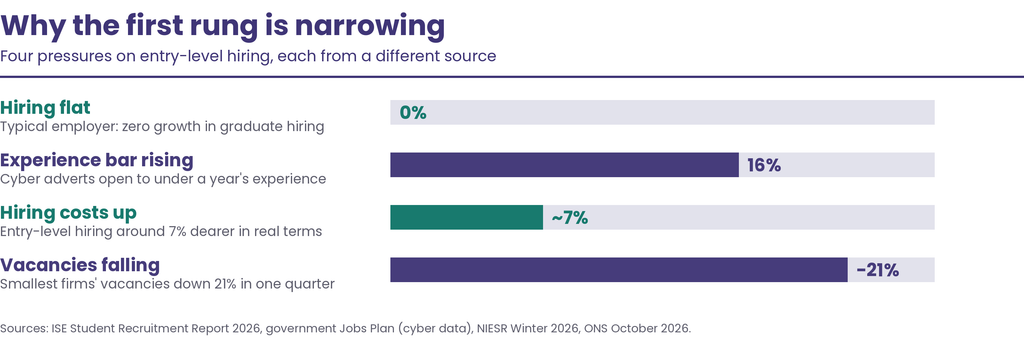
Hiring is flat, not collapsing. The Institute of Student Employers’ 2026 recruitment report found graduate hiring rose 4%, but that growth came mostly from a handful of large employers. Without them, growth was 0.8%, and the typical employer’s was zero. Within that:
- 40% of employers cut their graduate intake, while 45% increased it
- growth in school and college leaver hiring slowed from 20% in 2022/23 to 4% this year
ISE’s survey covers larger employers with structured programmes, so it says little about smaller firms.
The experience bar is rising. In core cyber security, a growing field, the share of job adverts seeking candidates with under a year’s experience fell from 25% in 2022 to 16% in 2025, while 64% asked for two to six years. The government’s analysis with LinkedIn suggests employers favour experienced candidates where applicants are plentiful.
Hiring junior staff costs more. NIESR estimates that higher employer National Insurance, National Living Wage increases and employment rights reforms have raised the cost of hiring for an entry-level position by around 7% in real terms. The IFS found a similar rise, 7.1%, for a full-time worker on the National Living Wage in 2025-26.
Smaller firms feel it most. ONS figures show vacancies at businesses with 1 to 9 staff fell 21% in the latest quarter, with those firms citing labour costs.
AI is part of the story, but not yet the proven cause. The government notes that some of the largest falls in entry-level hiring are in roles where AI has advanced fastest, such as software engineering and data analysis, but says this is not yet evidence that AI is the cause. Among large employers, 82% expect AI to replace no or very few early-career roles.
The stakes are high. NIESR projects that more than 1 million young people will remain not in education, employment or training over the next five years.
The Real Risk: Losing the Work Juniors Learned On
The numbers above show where the squeeze is. What follows is why it matters beyond the headline.
The government’s plan states the problem directly: entry-level roles are how the sector develops its future senior engineers and specialists, and if they are cut rather than redesigned, the shortages of experienced staff that employers report today are likely to grow.
That isn’t a prediction about technology. It’s a statement about how people learn. Junior roles have always doubled as training: the routine tasks that made up the first year or two of a job were also how someone learned how the business worked, how decisions were made and what good judgement looked like.
AI is now taking over many of those tasks. The ISE’s 2026 survey found that the work most likely to be affected is routine admin, basic data handling and standard writing, while critical thinking, AI literacy, communication and adaptability are growing in importance. That shift is consistent across sectors.
What matters for HR is what’s happening in practice. The same survey found:
- 87% of employers expect AI to reshape graduate and apprentice roles over the next three years
- 43% reported that roles had already evolved in response to AI, without any formal redesign
- 56% said AI had not yet led to noticeable changes
The 43% is the figure that should concern L&D teams most. It means the learning content of junior roles is changing without anyone reviewing whether the learning still works. A role that used to teach someone to draft, research or organise data may now skip those tasks entirely, and no one has decided what replaces them.
Our reading: if that redesign keeps happening by default rather than by design, organisations will find in three to five years that they have fewer people with the judgement, context and client skills that only come from doing the work at the start.
What a Redesigned Entry-Level Role Looks Like
The government’s plan describes what it expects. Early-career jobs should enable people to work alongside AI tools, gain practical experience and develop the judgement, oversight and application skills that remain distinctly human. A good placement needs defined tasks, a named supervisor, and a realistic view of what someone at the start of their career can contribute.
That is a job design question, and it sits with HR and L&D.
The ISE’s survey points the same way: employers prefer to develop digital and AI skills after hiring rather than screen for them, which means the learning has to be designed into the role.
In practical terms, redesigned entry-level roles shift from executing routine tasks to:
- Checking AI output before it reaches a customer, a manager or a decision
- Handling the cases AI hands over, where context, judgement or a human relationship matters
- Spotting where AI is wrong and understanding why, which builds exactly the expertise the organisation needs later
- Learning the business through structured rotation, mentoring and real projects rather than through the routine tasks AI now does
None of that happens on its own. It needs to be designed, supervised and reviewed, which is what L&D does.
The CIPD’s 2026 data suggests a gap here. Only 46% of HR leaders feel confident leading job redesign, and only 40% feel confident designing reskilling pathways. Those are the two capabilities this work depends on most.
The government’s £20 million Early Careers Jobs Alliance is looking at the same question, mapping how entry-level work is changing as AI is adopted and recommending how businesses can redesign roles while keeping entry-level pathways open. Its initial report is due to be published soon.
What HR and L&D Should Do Now
Most of these steps don’t need a budget or a policy decision. They need someone to look at what’s already changed and decide what to do about it.
- Find out what’s already shifted. Ask managers which tasks their juniors no longer do, and whether anything has replaced them. The ISE’s finding suggests this has happened in many organisations without HR knowing about it
- Redesign deliberately. For each entry-level role, set out what the person will learn in their first year, what AI does and what the person does, and who supervises the handover between the two. The same criteria apply to a permanent hire as to a placement
- Build learning into the job, not around it. The ISE found employers are almost twice as likely to develop digital and AI skills on the job as to recruit for them. That only works if the role is designed for it, with time, structure and someone responsible for the learning
- Use the funded routes. The support listed in Section 2, from fully funded under-25 apprenticeships to the £3,000 Youth Jobs Grant, is designed to reduce the financial risk of hiring someone with limited experience
- Consider a Skills Deal commitment. The government is asking every employer to make one measurable commitment by 2030 and report on it publicly. A commitment doesn’t have to be large, but it does have to be specific, and making one is a way to formalise early-careers investment that might otherwise be the first thing cut
- Track it. Early-career hiring, retention and progression should be workforce metrics, reviewed alongside headcount and turnover. If no one measures whether juniors are learning what the organisation needs them to learn, the gap in Section 4 grows without anyone seeing it
Explore: Is HR Ready to Govern AI at Work?, for why the same capability gap shows up in AI governance.
How Avado Can Help
Redesigning entry-level roles, building learning into them and measuring whether it works are all L&D skills. They sit at the centre of what the CIPD calls “learning and development design to create value”, which is one of the core units of its Level 5 qualification.
Avado’s CIPD Level 5 Associate Diploma in Organisational Learning & Development builds that capability. It covers how to design learning that connects to business goals, how to support self-directed and social learning in the workplace, and how to facilitate personalised, performance-focused development, all of which apply directly to the early-careers challenge this piece describes.
Explore CIPD Level 5 L&D and build the skills to design early-career roles that develop people, not just fill seats!