

 9 min read

What is Employee Experience?
Employee experience (EX) describes what it’s like to work at an organisation, from the moment someone applies for a job to the day they leave. It includes every part of their working life – recruitment, onboarding, day-to-day work, learning, communication, support, and even the tools they use. All of these moments shape how employees feel and perform at work.
Deloitte’s 2025 Human Capital Trends report found that 74% of high-performing companies now treat EX as a shared business priority, not just something for HR to manage. This shows a growing shift in how organisations think about the role of people in their success.
Unlike job satisfaction or engagement, which focus on how people feel, EX looks at the full journey. It helps leaders ask better questions, like: what is it really like to work here, and how can we improve that?
In this guide, we’ll explore why EX has become so important in 2025, how to build a strong strategy, and what successful companies are doing to improve the everyday experience of their people.
The Business Impact of Employee Experience
Good employee experience (EX) can have a direct impact on business performance. When people don’t feel supported or engaged at work, the results often show up in poor productivity, high turnover, and extra costs.
Gallup’s 2025 Workplace Report shows that only 21% of employees worldwide feel engaged in their jobs, with lost productivity estimated at $438 billion a year. Disengaged staff are more likely to leave or speak negatively about their employer, which can also damage reputation over time.
On the other hand, companies that focus on improving the employee experience often perform better. LinkedIn’s 2025 Workplace Learning Report shows that businesses that prioritise development and support are more confident in their ability to stay profitable, attract skilled talent, and keep good people:
- 17% higher confidence in profitability
- Greater ability to attract top talent (71% vs 58%)
- Stronger confidence in retaining skilled employees (67% vs 50%)
Strong EX doesn’t just benefit employees, it helps organisations stay competitive in a changing job market.
Employee Experience vs Employee Engagement
Although people often confuse them, employee experience (EX) and employee engagement are not the same.
- Engagement is the result – how people feel about their job, team, and organisation.
- Experience is what shapes those feelings – including culture, processes, leadership, tools, and the working environment.
Gallup’s 2025 report shows that only 21% of employees globally feel engaged, suggesting that engagement programmes by themselves don’t go far enough.
Sustained engagement comes from designing better employee experiences. When each stage, from onboarding to development is handled thoughtfully, people are more likely to stay, grow, and contribute.
Mapping the Employee Journey
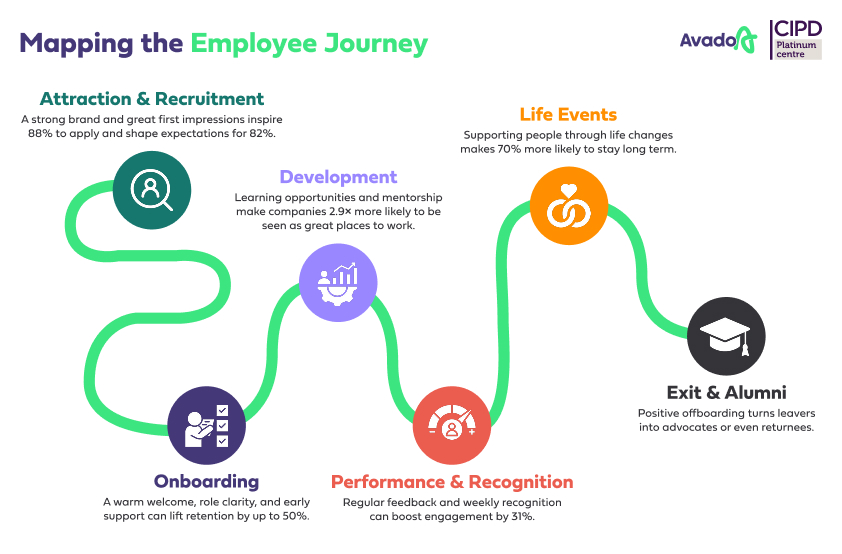
Understanding the employee journey helps organisations improve the experience at each stage – from first contact to exit. When each step is designed with care, it can improve trust, retention, and how people feel at work.
According to Gartner, companies tailoring the employee experience across the full journey see up to 27% better retention and 26% higher performance.
Here’s a simple overview of each stage:
Attraction & Recruitment
- A strong employer brand matters: 88% of candidates say it influences whether they apply
- 82% of job seekers say first impressions shape expectations
Onboarding
- Welcoming new starters, giving role clarity, and offering early support make a difference
- A good onboarding process can improve retention by up to 50%
Development
- Access to learning, clear career paths, and mentorship support growth
- Companies that invest in development are 2.9 times more likely to be seen as great places to work
Performance & Recognition
- Regular feedback, fair appraisals, and reward systems help people stay motivated
- Weekly recognition can boost engagement by 31%
Life Events
- Supporting people during personal changes, like parental leave or health issues, builds loyalty
- 70% of employees say they’re more likely to stay long term when life-stage needs are respected
Exit & Alumni
- Offboarding, exit interviews, and maintaining relationships with former employees all matter
- People who leave on good terms often become advocates, or even return later
Employee journeys aren’t always linear. Good experience design needs to be flexible, practical, and able to respond to what employees actually need, not just what suits internal processes.
How to Build an Employee Experience (EX) Strategy
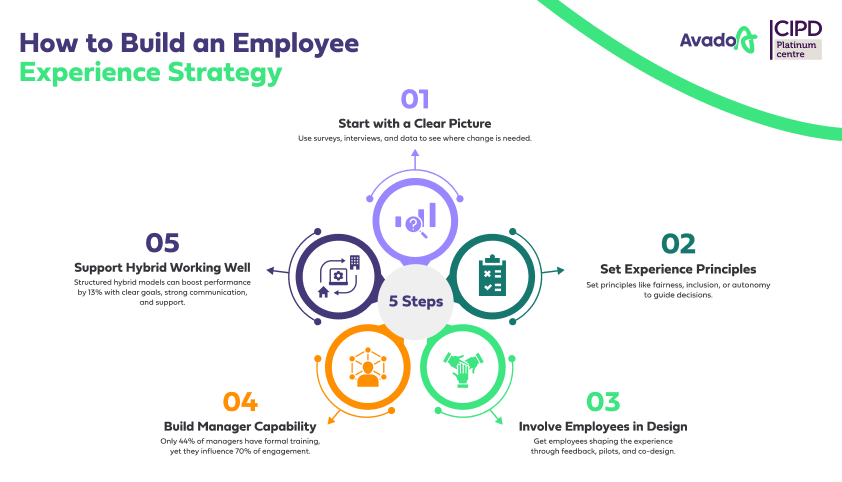
Building a strong employee experience strategy takes support from across the organisation. It also needs to align with your values, your people, and the way your business operates.
1. Start with a Clear Picture
Use surveys, interviews, focus groups, and workforce data to understand where the gaps are. This will help you focus your efforts on what really needs to change.
2. Set Experience Principles
Define what good looks like in your organisation. For example, you might focus on fairness, inclusion, or autonomy. These principles should guide how you design policies and processes.
3. Involve Employees in Design
The best experience comes when people are involved in shaping it. Use feedback sessions, pilot groups, or co-design workshops to make sure your systems feel useful, fair, and easy to use.
4. Train Your Managers
Line managers have a huge impact on how people feel at work. Yet Gallup’s 2025 Global Workplace Report found that only 44% of managers have had any formal training. Because 70% of team engagement is directly attributable to line managers, building their capability is essential.
5. Support Hybrid Working Well
Data from The Guardian shows that structured hybrid models can improve performance by up to 13%. This means more than just offering remote work, it’s about clear goals, good communication, and support for team members wherever they’re based.
Improving leadership capability and designing inclusive, flexible systems helps create a workplace where employees can perform at their best and are more likely to stay.
Employee Experience Metrics & Measurement
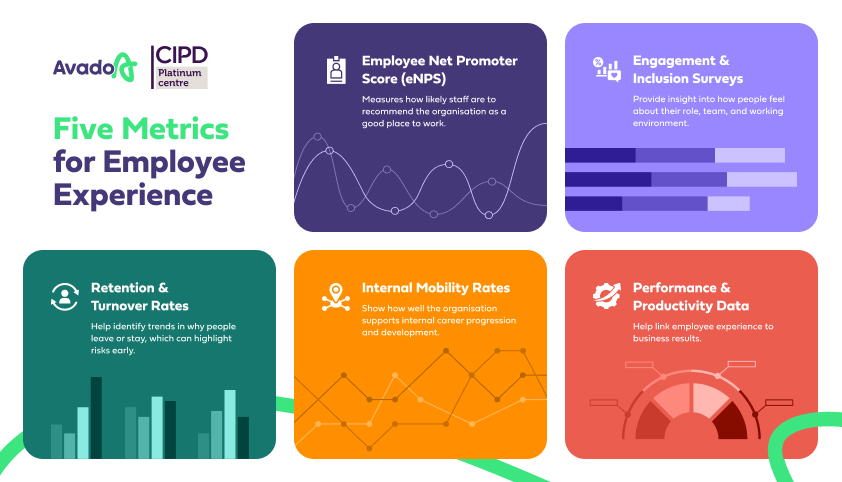
Measuring employee experience helps organisations understand what’s working and where improvements are needed. Tracking the right data over time can make a real difference to retention, engagement, and performance. Some of the most useful indicators include:
- Employee Net Promoter Score (eNPS): Measures how likely staff are to recommend the organisation as a good place to work.
- Engagement and inclusion surveys: Provide insight into how people feel about their role, team, and working environment.
- Retention and turnover rates: Help identify trends in why people leave or stay, which can highlight risks early.
- Internal mobility rates: Show how well the organisation supports internal career progression and development.
- Performance and productivity data: Help link employee experience to business results.
The CIPD Good Work Index (2025) found that 70% of employees who feel valued also report higher job satisfaction and wellbeing. Those who don’t feel recognised are much more likely to feel disengaged and think about leaving.
Great Employee Experience Examples
The 2025 Great Place to Work list highlights companies of all sizes that consistently deliver strong employee experiences. Here are three UK-certified organisations setting the standard.
Hilton
At Hilton, 92% of employees say it’s a great place to work. Most feel welcomed from the start, with 96% saying they are treated fairly regardless of their background. This suggests that a clear and inclusive approach to onboarding can leave a lasting impression.
NVIDIA
96% of NVIDIA employees rate it as a great workplace. High scores in safety, fairness and respect point to a culture that supports trust and wellbeing, both in the office and in remote settings.
Admiral Group
At Admiral, 87% of staff say the company is a great place to work. Nearly all feel safe and treated fairly, which reflects a culture where inclusive behaviour is part of daily practice, not something saved for policy statements or campaigns.
These examples show that creating a positive employee experience isn’t limited to global tech firms or high budgets. Listening, fairness, and consistency go a long way, regardless of company size or sector.
Technology’s Role in Employee Experience
Digital tools are now a major part of how people experience work, from onboarding to development, performance, and wellbeing. Recent data highlights both progress and gaps:
AI Adoption
According to McKinsey, almost all organisations are investing in AI, but only 1% describe their use as mature or well-integrated.
Employee use of AI
A Report from Boston Consulting Group highlights that 72% of employees globally now use AI tools at work. In India, the figure is even higher, at 92%, especially where workflows have been redesigned for efficiency.
Time Savings
According to The Guardian, Grace Orr, Director of People at Communicorp UK, implemented an AI-enabled payroll platform. This shifted the monthly payroll process from taking one to two days down to just one hour, freeing HR time for more meaningful work.
People Analytics Gaps
A 2025 UK Digital Maturity Survey, referenced in TechRadar, reveals that less than one-third of organisations (only 29%) say they use data effectively for strategic decision‑making. It highlights a significant gap between digital investments and actual data-driven usage.
Digital tools can improve the way people experience work, but they should support, not take the place of, genuine human connection.
Putting Employee Experience into Practice
Improving employee experience is a long-term commitment to how people feel, work, and grow within your organisation. As expectations shift and hybrid models continue to evolve, organisations that pay attention to EX are better placed to keep talent engaged and performing at their best.
HR plays a central role in making this happen. By building the right skills and aligning people strategies with what employees actually need, HR teams can help create workplaces where people want to stay. Explore Avado’s CIPD and programmes to strengthen capability and deliver meaningful change.
- CIPD Level 3: The CIPD Level 3 Certificate in People Practice is perfect for those beginning their HR or L&D journey.
- CIPD Level 5: The CIPD Level 5 Associate Diploma in People Management helps experienced HR professionals deepen their expertise and drive more impactful outcomes.
- CIPD Level 5 L&D: The CIPD Level 5 Diploma in Organisational Learning and Development supports L&D practitioners aiming to lead change and build learning cultures.
- CIPD Level 7: The CIPD Level 7 Advanced Diploma empowers senior HR leaders to influence business strategy and shape the future of work.