

 8 min read

There’s no denying it: professional qualifications like the CIPD come with a financial commitment. For many aspiring HR and L&D professionals, especially those early in their careers, the cost can feel like a barrier to progression. And for employers, the idea of investing in training during tight budget periods might raise eyebrows.
But here’s the good news: you don’t have to take it on alone. Many organisations are already investing in their people through professional development funding. And more would consider it if they understood the business case behind it.
Why Investing in CIPD-Qualified People Pays Off
Smart businesses understand that HR isn’t just a support function, it’s a strategic engine for growth. An organisation’s ability to adapt, compete, and retain talent is often determined by the strength of its people strategy. And that strategy depends on having capable, qualified HR professionals.
A CIPD-qualified professional brings far more to an organisation than theoretical knowledge. They bring:
- Increased HR effectiveness: Qualified HR professionals are better equipped to manage complex employee relations issues, including grievances, disciplinaries, and organisational change. CIPD’s most recent Health and Wellbeing at Work report found that high workload is cited by 69% of employees as a driver of poor mental health at work, and that line manager buy-in for supporting wellbeing has risen to 75%, up from 58% five years ago. Training HR staff to build that management capability helps fill the gap, leading to quicker conflict resolution, fewer escalations, and stronger internal support.
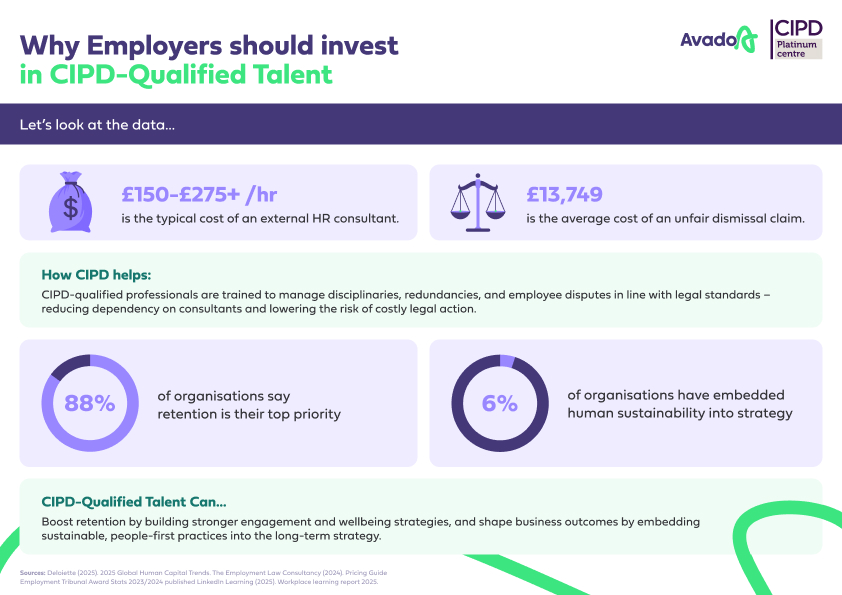
- Cost savings: In-house HR capability reduces the need for external consultants or legal advisors, which can come at a significant cost. Employment law consultancy fees in the UK typically range between £150 and £275+ per hour, depending on complexity and seniority. For issues such as disciplinaries or restructures, businesses can save thousands by managing these internally with properly trained professionals.
- Risk mitigation: Avoiding legal disputes isn’t just good practice, it’s a financial imperative. The most recently published tribunal award data (2023/24) put the average compensation for unfair dismissal at £13,749, while discrimination awards varied widely by type: £29,532 on average for race discrimination, £53,403 for sex discrimination, and around £100,000 for age discrimination, though that last figure is based on a small number of cases and can swing considerably year to year. The unfair dismissal compensation cap now stands at £123,543 (up from £118,223 the year before), and with employment tribunal claims up sharply again in 2025/26 according to official Ministry of Justice statistics, this risk is only becoming more pressing rather than less.
- Evidence-based decision-making: As organisations seek to retain talent and navigate rapid change, data-led people strategies are essential. According to LinkedIn’s Workplace Learning Report 2025, 88% of organisations cite employee retention as a key concern, with learning opportunities identified as the top retention strategy. CIPD learners are trained in HR analytics and evidence-based practice, enabling them to make informed, measurable decisions that align HR outcomes with business performance.
- Stronger alignment with business strategy: Modern HR goes far beyond policies and procedures, it plays a critical role in shaping culture, driving change, and enabling leadership to build a high-performing organisation. Deloitte’s 2026 Global Human Capital Trends report found that 7 in 10 business leaders now see speed and adaptability as their primary competitive strategy for the next three years, a shift that puts HR’s ability to reskill and reorganise people quickly at the centre of business performance, not on the sidelines. CIPD training gives professionals the mindset and skills to operate at this level.
And in today’s rapidly evolving workplace, where AI adoption, remote work, DEI expectations, and talent retention are all pressing issues, the need for well-trained, strategic HR and L&D professionals has never been more urgent. Businesses that invest in this capability now will be better equipped to navigate future disruptions and retain a competitive edge.
The Organisational Benefits of Supporting CIPD Study
Let’s look at this from the organisation’s perspective. Supporting an employee’s CIPD qualification is not just an act of goodwill, it delivers measurable benefits across the business.
- Loyalty and retention: Employees who feel supported in their professional growth are more likely to stay. Development opportunities build a sense of commitment and trust, which in turn reduces attrition. In a competitive job market, this can significantly reduce hiring costs and the disruption caused by staff turnover.
- Better hiring outcomes: CIPD-qualified professionals bring sharper skills in recruitment and talent management. They understand the full employee lifecycle, from attraction and selection to onboarding and engagement. This leads to better hiring decisions, improved candidate experiences, and stronger long-term fits.
- Internal development beats external hiring: Promoting from within is not only more cost-effective but also more culturally aligned. When organisations invest in upskilling their own people, they nurture future leaders who already understand the business, values, and team dynamics. This accelerates time-to-impact compared to onboarding new hires.
- Enhanced employer brand: Organisations that actively support professional development are more attractive to both current employees and potential candidates. It signals that the company values learning, invests in its people, and is serious about building long-term careers.
- Future-proofing your people strategy: As the people profession evolves with new technologies, shifting legislation, and changing employee expectations, having a team that is continuously learning and certified by a trusted body like CIPD gives businesses the agility to adapt.
Exclusive Avado Advantage: Mock Employment Tribunals
Avado’s upgraded Plus Package includes access to two Mock Employment Tribunals, a unique feature that allows learners to experience simulated employment dispute scenarios in a structured, low-risk environment. These practical exercises provide hands-on insight into the legal and procedural challenges of employment law, equipping learners with skills they can immediately apply in the workplace.
This is especially relevant right now:
- Employment tribunals received around 50,000 new single claims in 2025/26, a 39% increase on the previous year, while disposals have not kept pace.
- The unfair dismissal compensation cap rose to £118,223 from April 2025, and the Employment Rights Act 2025, which received Royal Assent in December 2025, will remove that cap entirely from January 2027.
- The same Act is also reducing the unfair dismissal qualifying period to six months and extending tribunal time limits from three to six months, changes expected to push claim numbers higher still over the next two years.
These changes generate prolonged uncertainty for both employers and employees, and the financial stakes are only rising. By proactively investing in CIPD-qualified employees with real-world training like Avado’s Mock Tribunals, organisations can build internal HR expertise that reduces risk, ensures legal compliance, and addresses workplace issues before they escalate.
How to Ask for Funding (With Support)
If you’re considering a CIPD course but unsure how to cover the cost, start by speaking to your employer. You might be surprised at how open they are, especially if you present a clear business case.

To help, Avado offers a downloadable business case template that outlines the organisational benefits in clear, commercial terms. It includes:
- Commercial Benefits: Show your employer how your new skills in talent management, employee relations, and HR strategy will improve organisational performance and reduce external consultancy costs.
- Course Insights: Provide a detailed overview of what you’ll learn, including HR analytics, employee engagement strategies, and organisational development.
- Time and Flexibility: Highlight the manageable time commitment and the online nature of the course, ensuring you can continue contributing to work while advancing your skills.
- ROI for Employers: Emphasise the benefits of having an HR professional trained at a more advanced level, improving workforce management, productivity, and compliance.
You don’t need to be a senior manager to make the case. Just:
- Start a conversation with your line manager or L&D team
- Show how the qualification aligns with your current role and future potential
- Reference examples from your work that could benefit from the skills you’ll gain
Many learners have successfully secured full or partial funding using this approach.
Don’t Let Cost Stop You
If the price of a CIPD qualification has made you hesitate, remember this: there are options. And in many cases, employer funding is a viable and mutually beneficial path forward.
By developing qualified people professionals, organisations strengthen their HR capability and future-proof their workforce. And as a learner, you gain confidence, credibility, and career momentum.
Explore Avado’s CIPD Courses
- CIPD Level 3 HR Courses: The CIPD Level 3 Certificate in People Practice is ideal for anyone looking to start a career in either HR or Learning and Development.
- CIPD Level 5 HR Courses: The CIPD Level 5 Associate Diploma in People Management will help you build on your existing HR knowledge.
- CIPD Level 5 L&D Courses: The CIPD Level 5 Diploma in Organisational Learning and Development is the most comprehensive course available for L&D professionals, ideal for you if you want to formalise your existing experience, skills and knowledge.
- CIPD Level 7 HR Courses: The CIPD Level 7 Advanced Diploma is aimed at expanding learners’ autonomy so they can strategically direct organisations and their people.
Frequently Asked Questions
Will my employer pay for my CIPD qualification?
Many employers will, especially when presented with a clear business case showing the commercial benefits. It’s worth asking even if you’re not in a senior role.
What’s the risk of not having CIPD-qualified HR staff?
Employment tribunal claims are rising sharply, and the average unfair dismissal award already runs into five figures. Untrained HR teams are more exposed to costly disputes and compliance failures.
Is CIPD training tax-deductible for employers?
Employers can typically treat work-related training costs, including CIPD qualifications, as a deductible business expense, though it’s worth confirming the specifics with an accountant, as tax rules can vary by circumstance.